
Management
AI Code Review: Manage the Verification Bottleneck
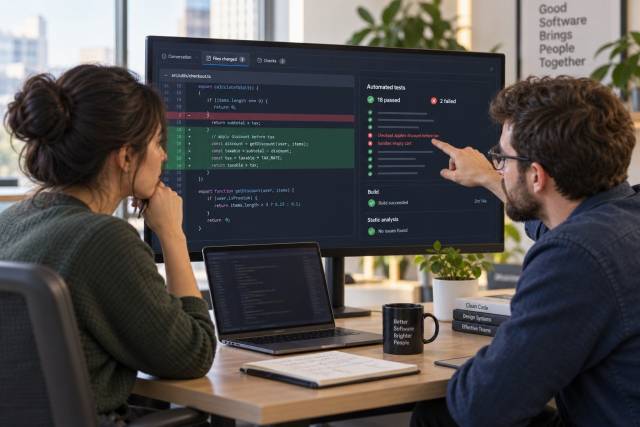
AI code review becomes a management problem when generated changes arrive faster than the team can understand and verify them. The answer is to manage the flow and evidence around those changes, not simply ask senior developers to read more code every evening.
Make change size a behavioral decision
A hypothetical AI-assisted PR fixes an authorization flaw in a private attachment download, reformats twenty files, and replaces an unrelated utility library. Even if the assistant produced it quickly, those changes create several different review questions.
Separate unrelated mechanical work and independent behavior changes where practical. For this attachment fix, keep the resource-ownership check with tests showing that its owner can download and another user cannot. Move formatting and the unrelated library replacement into separate work. The reviewer can then assess one security boundary without also accepting a dependency migration.
Avoid an absolute line-count rule. Generated fixtures can be large and straightforward; a tiny change to a permission check can be consequential. DORA's small-batch guidance supports feedback-friendly work without reducing judgment to a number.
Establish an author-owned evidence package
Before asking for review, the author should provide:
| Evidence | Why the reviewer needs it |
|---|---|
| Intended behavior | Establishes what the change should accomplish |
| Important boundaries | Identifies permissions, data, and operational assumptions |
| Tests actually run | Separates verified behavior from an assertion |
| Known gaps | Makes remaining uncertainty visible |
| Deployment implications | Exposes migrations, configuration, and recovery needs |
These expectations apply to human-written changes too. AI increases the importance of maintaining the standard when producing a draft becomes easier.
A summary generated by the same assistant that wrote the code is a proposal to verify. The author must check that it accurately describes the implementation.
Treat AI code review as part of delivery capacity
The 2025 Stack Overflow survey reports widespread frustration among respondents with AI answers that are close to correct and with debugging effort. Those responses establish a verification concern, not a rule that all AI output is poor.
The management implication is that implementation output and review capacity need to stay balanced. If the team produces twice as many proposals while the review queue grows, throughput at the drafting stage has improved but the delivery problem remains.
Include author preparation, review, corrections, and validation in planning. Do not allocate the reviewer a full implementation workload and assume these responsibilities will fit around it.
Define who can accept which risk
A developer can own ordinary implementation verification within the team's standards. A migration, billing change, or new external data flow may require additional expertise or operational approval.
Publish the review expectations for those change types. Reviewers need a backup path, and authors need to know what evidence is required before the PR enters the queue.
Do not send every change to the same senior engineer merely because it used AI. Route according to behavior, consequence, and competence. My technical guide to reviewing AI-generated PHP code covers the code-level checks behind this distinction.
Should AI-generated code require extra review?
Review should match the consequence and uncertainty of the change. AI output may introduce unfamiliar code or unsupported assumptions, which require attention, but the tool alone does not determine the risk category.
Use AI assistance without circular approval
An AI reviewer can suggest edge cases, explain unfamiliar code, or identify candidate defects. Treat the findings as leads. Confirm a reported issue through reasoning, tests, or a reproduction before changing the implementation.
Likewise, the absence of an AI finding does not prove correctness. Two automated agents agreeing on a plausible explanation are not equivalent to independent acceptance evidence.
The team should know who ultimately accepts the change and what supports that decision. “The bot approved it” is insufficient ownership for a consequential production behavior.
Who is responsible for a defect in generated code?
Use the same accountable ownership and incident-learning process as other code. The author and review process must establish acceptance; an AI tool cannot assume organizational responsibility.
Watch the queue and the rework
Review time to first substantive response, repeated clarification, and the amount of work returned for basic preparation. Interpret the measures by change type and working hours.
If authors routinely omit tests, improve preparation. If qualified reviewers are saturated, reduce new starts or develop additional coverage. If generated changes frequently misunderstand requirements, improve the input and acceptance examples before optimizing review speed.
Avoid measuring success through issues reported by the bot or comments written by reviewers. More findings can reflect more noise, larger changes, or weaker preparation.
How can a manager reduce the review bottleneck?
Improve author preparation, keep changes focused, plan reviewer capacity, and train backup reviewers. Measure whether accepted changes move faster without increasing rework or operational problems.
Keep learning in the loop
Ask authors to explain important tradeoffs and corrections. Pair on difficult findings so knowledge spreads instead of leaving the senior reviewer to repair every generated change.
My practical AI workflow for WordPress developers treats AI as part of a development process. The leadership responsibility is to make that process maintainable for the whole team.
If AI has accelerated drafts but overloaded review, my AI workflow consulting can help identify where the delivery process needs to change.