
Development
How I’m Rebuilding a Developer Audience One Useful Post at a Time

I am rebuilding my developer audience in public, one useful article at a time.
This is not a case study about explosive growth. I do not have a chart proving that a publishing schedule produces a particular number of subscribers, visits, or clients. What I have is a strategy grounded in work I know well: own the home base, write from firsthand experience, publish substantial articles on a schedule I can sustain, distribute them selectively, and let real reader signals improve the next topic.
That is how I am trying to build an audience as a developer without turning content production into a second full-time job or filling the web with generic AI prose.
How can you build an audience as a developer?
Quick answer: choose a professional territory you can explore for years, publish in a medium you can sustain, and use a repeatable angle rooted in your own work. Put the canonical version on a site you control. Keep a realistic cadence, share each article where the right readers already spend time, listen to their questions, and use those signals to decide what deserves a follow-up.
My version is long-form technical writing on mikelopez.com, with Saturday as an anchor and additional posts scheduled on weekdays. The territory is PHP, WordPress, AI-assisted development, software practice, product work, and engineering leadership. The repeatable angle is practical evidence from building and maintaining real systems.
AI helps me research, produce, and verify the work. It does not supply the experience or approve the final article.
This is the third part of a small publishing system
The first article in this series explains why I switched mikelopez.com from WordPress to a static site. That decision gave the publication a lightweight, inexpensive home that I control.
The second explains my AI-assisted blogging workflow from idea to GitHub issue to pull request. That process makes it possible to plan several articles, preserve each brief, review the implemented result, and schedule approved work without lowering the quality bar.
This article explains what those choices are for: building a useful body of work and a direct relationship with readers over time.
The platform, workflow, and audience strategy support one another. A reliable home makes every article durable. A repeatable workflow makes the cadence plausible. A clear audience strategy decides what is worth putting through that workflow.
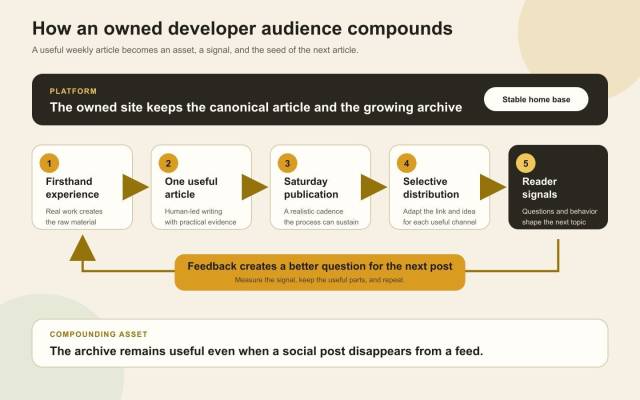
The goal is not a viral spike. It is an owned archive that becomes more useful with every cycle.
Why owning the home base matters
Social networks, communities, newsletters, search engines, and publishing platforms can all help a developer reach people. I do not need to pretend they are useless in order to value an owned site.
The distinction is control.
On mikelopez.com, I control the canonical URL, archive, presentation, internal links, performance budget, publication schedule, and source files. An older article can keep answering a useful question long after the social post that introduced it has disappeared from a feed.
An account on another platform is rented distribution. Its rules, formats, reach, and priorities can change. That does not mean I should avoid those platforms. It means I should use them to bring the right readers toward a body of work that remains accessible on terms I can maintain.
Ownership also improves the writing. I am not forced to compress every idea into the format favored by one feed. I can explain the trade-offs, link the evidence, show code or diagrams, and update the article later when reality changes.
The site is the source of truth. Distribution is a set of replaceable paths into it.
I am applying Copyblogger's topic, medium, and angle framework
Tim Stoddart's Copyblogger guide, How to Build an Audience From Scratch In 2026, begins with three choices: topic, medium, and angle. It argues that the topic should match genuine knowledge and interest, the medium should be something the creator can produce consistently, and the angle should be both distinctive and repeatable.
That framework helped me state my choices plainly.
Topic
My broad topic is the practice of building software and technical products. Within that territory, I have a few connected areas where I can contribute something earned rather than assembled:
- PHP and WordPress development
- Plugin architecture, security, compatibility, and maintenance
- AI-assisted development and responsible review
- Web performance and pragmatic infrastructure
- Product engineering and long-lived codebases
- Engineering leadership, collaboration, and decision-making
These are not six unrelated content niches. They are parts of the same career. A WordPress plugin decision can involve PHP design, product judgment, team communication, performance, and AI-assisted tooling in the same week.
Medium
My primary medium is text on an owned website.
Long-form writing fits the way I explain technical decisions. It gives me room to show why an approach worked, where it did not, and which context would change the recommendation. It also fits a static publishing system that produces fast, accessible pages and a durable searchable archive.
Text is not inherently superior to video, audio, or social posts. It is the medium I can sustain while continuing to do the work that gives me something worth saying.
Repeatable angle
My angle is practical guidance from an experienced developer who still works close to the code, product, and team.
My PHP and WordPress work gives me firsthand examples from code, products, and teams. I can explain a decision using the failure modes, maintenance costs, customer needs, and operational constraints that polished tutorials often omit. I can also say when WordPress remains the right choice, as I did in my article about why I still develop for WordPress.
The repeatable question behind the site is: what can another developer use from this experience?
Usefulness is the publishing filter
The internet does not need another article merely because I can generate one.
A useful post should help a specific reader understand a decision, solve a problem, avoid a mistake, or ask a better question. It should contain enough context for the reader to know whether the advice applies to them.
That standard changes which ideas make the schedule. “Thoughts on AI” is too broad. A tested workflow for reviewing AI-generated PHP has a reader, a risk, and a practical outcome. “Make websites fast” is vague. A documented path from a 67 mobile performance score to repeatable 100s gives another developer evidence and an ordered checklist.
Usefulness also protects the audience from my publishing calendar. A scheduled date is not permission to pad a thin idea. If a topic lacks experience, evidence, or a clear reader outcome, it needs more work or should leave the queue.
Firsthand experience matters more in an AI-heavy web
Copyblogger notes that AI tools have increased the supply of content while making authentic messages more valuable. I agree with the direction, but authenticity needs a practical definition.
For me, it means being able to answer:
- What did I actually do?
- Which constraint made the decision difficult?
- What evidence changed my mind?
- What failed or took longer than expected?
- Which trade-off would make me recommend a different choice?
- What am I still measuring instead of claiming?
AI can help organize those answers. It cannot manufacture their credibility.
This is why I do not see AI assistance and human voice as opposites. AI increases production capacity, which makes undifferentiated content easier to create and easier to ignore. The valuable part becomes the judgment and evidence the tool cannot obtain unless an experienced person supplies it.
My job is not to hide AI involvement. It is to ensure that assistance never crosses into invented experience, unsupported certainty, or outsourced responsibility.
Why I use a flexible publishing schedule
Copyblogger recommends choosing a realistic publishing frequency and warns against a schedule that causes the creator to quit. That is the part of consistency advice I find most useful.
My current queue includes substantial weekday posts as well as Saturday articles. Saturday is an anchor for the plan, not the only day I publish. The batch workflow makes this busier stretch possible, but I still need to judge each article on its usefulness rather than defend a fixed post count. Publishing only when inspiration appears would make the site easy to neglect.
The workflow gives each idea enough room for:
- Source research and factual verification
- A complete first draft and editorial revision
- Original, correctly sized images
- Image optimization and metadata removal
- Normal and scheduled preview builds
- Automated regression tests
- Desktop and mobile visual review
- Repeated Lighthouse performance audits
The calendar is a constraint, not the purpose. Its job is to make practice regular. If the process proves unsustainable, I should adjust it based on evidence rather than protect an arbitrary promise.
Batching supports consistency without batching away the voice
Planning several articles together solves a different problem from writing several generic articles at once.
In a planning batch, I can agree on the angle, audience, outline, sources, internal links, images, CTA, and date for each article. Each approved brief becomes its own GitHub issue. Production then happens separately on an isolated branch and ends in a draft pull request for human review.
This reduces repeated setup decisions while keeping every article distinct. The static-site article is about platform choice. The workflow article is about production discipline. This one is about audience strategy. They reinforce one another without becoming three variations of the same post.
I do not want batching to flatten the voice. Personal examples, conclusions, and recommendations still need individual attention. The batch organizes the work around the writing. It does not replace the thinking inside it.
AI should increase capacity, not manufacture authority
AI is valuable in this strategy because the production standard includes many tasks beyond prose. It can inspect existing content, research approved sources, check internal links, propose structure, help create images, implement Markdown, run builds, review generated HTML, and repeat performance tests.
That extra capacity lets me spend more attention on the decisions that benefit from experience.
The danger is that the same capacity can produce confident articles on subjects where I have nothing original to contribute. A technically clean draft can still be empty. A plausible example can still be false. A passing build can only prove that the page works, not that the advice deserves a reader's trust.
The workflow therefore keeps explicit human gates before production and before merge. AI assists within an approved scope. I remain accountable for the published result.
Publish on the owned site first, then distribute selectively
I want every substantial idea to have one canonical version on mikelopez.com. After publication, I can adapt the idea for the channels where it is relevant.
That might mean sharing a concise lesson, a diagram, a specific result, or a question that the full article answers. The platform-native post should be useful on its own rather than a misleading teaser, but the durable explanation remains on the owned site.
I do not need to distribute everywhere at once. A developer audience is more likely to grow from repeated relevance in a few appropriate places than from automated copies sprayed across every available network.
Selective distribution also creates clearer feedback. If a particular explanation prompts good technical questions, those questions can improve the article or become the seed of another one.
Feedback should shape the next useful topic
The publishing plan is a hypothesis. Reader behavior is part of the evidence.
I will look for signals such as:
- Questions people ask in replies or conversations
- Search queries that reveal a more specific need
- Articles readers return to or continue reading from
- Internal links that help readers explore a related topic
- References and links from other practitioners
- Direct requests for a deeper example or implementation detail
- Relevant consulting conversations that expose a repeated problem
Not every signal deserves a chase. A sudden burst from an unrelated query can be noise. One thoughtful question from the exact reader I want to help can be much more useful.
The goal is to find patterns, publish a better answer, and repeat the cycle. Feedback should sharpen the territory rather than pull the site toward every passing trend.
What I will measure without pretending the result exists
Because this is an experiment in progress, the first measurements should describe the process and the quality of attention.
I want to track:
- Whether the planned mix of Saturday and weekday posts remains sustainable
- Which topic clusters earn sustained search impressions and useful clicks
- Which articles lead readers to another relevant page
- Which posts attract specific questions, references, or replies
- Whether returning readership grows over a meaningful period
- Which distribution channels send engaged readers rather than brief spikes
- Whether the articles create appropriate professional conversations
I am not publishing a starting traffic number or promising a growth rate here. A later case study should compare an actual baseline with a defined period and explain what else changed. Until that evidence exists, the honest claim is that I have designed a system and committed to testing it.
Frequently Asked Questions
How can a developer build an audience online?
Choose a focused professional territory, a sustainable medium, and a repeatable angle based on real experience. Publish useful work consistently, distribute it where relevant readers gather, and use their questions and behavior to improve later topics.
Does a developer need a personal website to build an audience?
No, but an owned site gives the work a stable canonical home. Social and community platforms can provide distribution, while the personal site preserves the archive, presentation, links, and reader path under the developer's control.
What should a developer write about?
Write where experience and reader need overlap. Good topics often come from difficult decisions, recurring bugs, migrations, performance investigations, code reviews, product trade-offs, and questions teammates or customers repeatedly ask.
How often should a technical blogger publish?
Choose a cadence that lets you maintain quality over time. My current calendar uses Saturday as an anchor and includes selected weekday posts; I will adjust it if the pace weakens the work. Another developer may be better served by publishing every two weeks or monthly.
Can AI help build a personal brand without making the content generic?
Yes, if AI handles bounded research, production, and checking tasks while the developer supplies the experience, point of view, evidence, and final approval. Generic output usually begins when the tool is asked to invent those human inputs.
Is an owned blog better than relying only on social platforms?
An owned blog offers stability and control, while social platforms can offer reach and conversation. The useful strategy is often to publish the canonical article on the owned site and use selected platforms for appropriate distribution.
What should a new developer blog measure first?
Start with publishing consistency, search discovery, meaningful reader questions, internal navigation, returning readership, relevant referrals, and professional conversations. Avoid treating a brief spike or a large impression count as proof of a durable audience.
Publish one useful thing you actually know
My audience strategy is intentionally unremarkable from one article to the next. There is no viral mechanism hiding inside it.
I own the site. I choose a territory earned through years of work. I plan articles in batches, produce them one at a time, use AI where it helps, and keep human judgment at the gates. I publish useful articles on the planned calendar, distribute them selectively, and let real feedback guide the next question.
Over time, that should produce something more valuable than a temporary spike: an archive of practical work and a clearer relationship with the developers it serves. Whether it grows as I expect is a result I still need to measure.
If you want to start or revive your own developer site, choose one useful topic from your direct experience. Define the reader and the decision it can help with, then commit to publishing it on a site you own.