
Leadership
Developer Focus Time Without Leaving Teammates Blocked
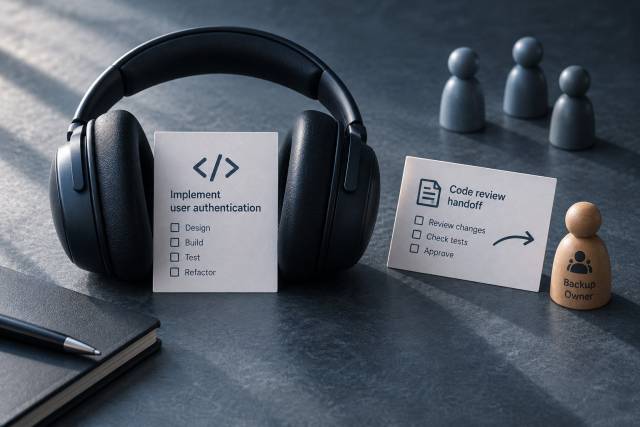
Developer focus time needs a communication agreement around it. Turning off notifications helps someone concentrate, but a teammate with a time-sensitive dependency still needs a reliable way to get a decision.
Reduce the interruption at its source
A vague “quick question?” creates an interruption before the recipient knows whether they are needed. Ask the actual question, link the context, state what was tried, and say when the answer matters.
For a hypothetical PHP team:
The retry-backoff PR is ready for review; its failure and recovery tests are linked. You are in a focus window until 14:00. Our agreed backup can assess this change, so I have assigned it to them for today's covered review window. If they cannot take it, please acknowledge it after 14:00 so we can revise the release plan.
In this hypothetical handoff, the developer uses an already agreed backup rather than inventing urgency to break the focus window. The backup has the relevant competence and authority; their name on a rota alone would not be enough. It also avoids making urgency depend on how many follow-up messages the requester sends.
Protect developer focus time with clear response classes
Start by distinguishing the kinds of messages your team receives:
| Message type | Example | Expected route |
|---|---|---|
| Incident | Production checkout is failing | Incident channel and on-call responder |
| Blocking decision | Today's release requires a scope choice | Named owner and backup |
| Review request | A normal PR is ready | Review queue and agreed working window |
| Routine question | Clarify a nonurgent implementation detail | Shared thread with context |
| Information | Release notes or an FYI | Read asynchronously |
The table is an example operating agreement, not an industry response-time standard. Agree on actual expectations with the people providing coverage.
A message sent outside someone's working hours should normally wait until they return. Planned on-call responsibility is different and should be explicit.
Is do-not-disturb appropriate during working hours?
Yes, when the team has agreed how ordinary messages and urgent situations are handled. Protected concentration and reliable escalation can coexist.
Provide a backup for decisions
Protected focus fails when every important question still routes to the same lead. Define which decisions a backup can make and which genuinely require the primary owner.
The backup needs context, authority, and access. Naming somebody who must ask the unavailable lead for approval simply adds another hop.
Use helping developers see the bigger picture as a principle here: a colleague who understands the purpose and constraints can make more decisions independently.
Should senior developers be available all day?
No. Their technical work also needs concentration. Provide review windows, office hours, documentation, and backup ownership so the team can get help without making one person permanently interruptible.
Treat reviews as planned work
A developer should not have to choose between meeting their own implementation commitment and reviewing everyone else's changes. Allocate review capacity when planning the week.
If the review queue grows, consider reducing new starts or shifting work to someone qualified to review. Protecting implementation time while leaving all completed code waiting does not improve delivery.
Agree on acknowledgement during a covered working window rather than a global instant-response target. People in different time zones should not need to monitor chat while asleep to keep a metric green.
Put focused work on the calendar realistically
Choose a few protected periods that fit the team's collaboration needs. Keep essential overlap available for reviews, decisions, or pairing when that improves flow.
Do not declare every morning meeting-free while scheduling mandatory planning calls there. Managers need to respect the arrangement in their own behavior.
A study of hybrid software engineers describes the tension between collaboration needs and meeting load. That supports designing both intentionally rather than assuming fewer meetings alone will solve the problem.
How many hours of focus time should developers get?
There is no universal target. Start with the work's needs and the team's current interruption pattern. Protect periods long enough for meaningful progress, then evaluate whether delivery and collaboration improve.
Model the behavior as a manager
Schedule nonurgent messages when practical, explain which requests can wait, and avoid praising people merely for answering late at night. Otherwise the stated agreement competes with the behavior that earns recognition.
When someone violates a response expectation, discuss the specific request and consequence. Do not infer indifference from an offline status. My guide to managing developer workload without burnout puts sustainable capacity at the center of that conversation.
Test whether the arrangement helps the team
Try the agreement for two weeks. Ask whether developers gained useful uninterrupted periods, whether consequential requests found an owner, and whether review or decision queues grew.
Look at delayed work in context. A request arriving just after a review window may need better timing, while a recurring urgent question may indicate missing documentation or delegation.
Avoid treating calendar adherence as the goal. If a short pairing session resolves a difficult problem, it may be the best use of a protected period. The agreement should support judgment.
If constant interruption is masking an ownership or planning problem, my technical leadership consulting can help identify and address it.