
Management
Project Documentation: Keep Decisions From Disappearing
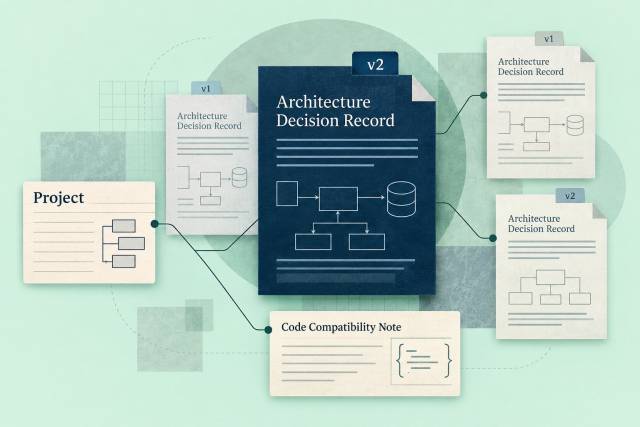
A maintainer sees an old dependency and starts upgrading it. Hidden in chat is the reason it was retained: the newer release breaks the product's supported PHP runtime. Project documentation should make that constraint discoverable before the next developer has to reconstruct it.
Capture decisions at the moment they happen
Suppose a hypothetical plugin team agrees in chat to retain support for its current minimum PHP version for one more release. A dependency upgrade needs a newer runtime, so the immediate implementation uses a compatible library release and defers the upgrade.
Record the decision as an explicitly hypothetical example:
Decision D-12, version 2: Retain the documented minimum PHP version.
Reason: Supported installations need a communicated transition period.
Consequence: Keep the compatible dependency release for this release cycle.
Revisit when: Product approves the runtime change and migration guidance.
Supersedes: D-12 version 1, which proposed an immediate minimum-version bump.
Owner: Technical lead, with Product owning the support commitment.
Link the versioned record from the dependency ticket and compatibility tests. A future maintainer can now distinguish an intentional constraint from a forgotten upgrade. Preserve version 1 as history, clearly marked as superseded, so an old chat link cannot quietly become current guidance.
The decision owner or a named participant should capture this when the choice changes. “Someone should document this” leaves the work unowned.
Should every chat conversation become a document?
No. Capture decisions, requirements, reusable explanations, and operational knowledge. Routine coordination can remain in chat if its outcome is already represented in the work record.
Organize project documentation around questions
In Atlassian's 2025 developer-experience report, finding information was a leading source of friction. The practical response is not automatically more documents. It is clearer routes to maintained information.
Start with what people repeatedly ask:
| Question | Authoritative record | Typical owner |
|---|---|---|
| What are we trying to achieve? | Outcome and acceptance examples | Product owner |
| Why did we choose this approach? | Decision record | Decision owner |
| How does this part work? | Repository documentation | Maintainer |
| What is ready to release? | Accepted work and release checklist | Release owner |
| What should Support tell a customer? | Approved product behavior and limitations | Product or support owner |
These owners maintain the meaning, not necessarily every sentence. Contributors can propose corrections through the team's normal review process.
Build a project index, not a document warehouse
A useful index can be short:
Project: PHP runtime compatibility transition
Outcome and acceptance examples: [link]
Current scope decision: [link]
Implementation notes and test commands: [link]
Release readiness and known limitations: [link]
Product owner: [name]
Technical owner: [name]
Last material change: [date and linked decision]
Keep the index close to the tracker entry or repository people already use. Avoid requiring a new tool merely to introduce another search destination.
Use descriptive link labels. “Minimum PHP version decision” is easier to recognize than “final-v3-updated.”
Keep technical facts near the code
Setup steps, test commands, architecture boundaries, and operational assumptions benefit from versioning alongside the implementation. A change to a command should update the instructions that use it.
Business priorities may belong in the product tracker. Incident procedures may live in an operational handbook. A single source of truth means one authoritative place for each fact, not necessarily one application for everything.
My article on the hidden costs of not documenting plugin code covers the maintenance consequence when essential context remains personal knowledge.
Make freshness visible
A recent edit timestamp does not prove a document is correct. Record who owns it and what event requires review: a release, changed dependency, altered customer promise, or failed onboarding step.
Label obsolete guidance and point to the replacement. Where a historical decision remains useful, retain it as history rather than presenting it as current policy.
Check access too. A perfect document that a new teammate cannot open still creates a blocker. Include permissions and searchability in the review, especially when contractors or partner teams participate.
Who should maintain project documentation?
The person accountable for each area should own its accuracy, with contributions from the team. Assigning everything to a single technical writer or manager can separate maintenance from the people making changes.
Run a findability test
Choose three ordinary questions and ask a teammate unfamiliar with the project to answer them using the index. Observe where they hesitate, find conflicting information, or need to ask someone privately.
Fix those gaps before reorganizing the entire knowledge base. Repeat after a significant project change or during onboarding. The useful measure is whether someone can reach the correct answer, not how many pages the team created.
Use AI search with source discipline
An AI assistant can help locate or summarize relevant records, but a confident answer does not resolve conflicting documents. Ask for links to the underlying sources and check the current authoritative record before acting on a consequential claim.
Do not use a generated summary to overwrite an unresolved disagreement. If two documents conflict, assign a human owner to settle which rule applies and update the source.
My practical AI workflow for WordPress developers emphasizes fitting AI into a controlled development process. The same principle applies to project knowledge.
Can an AI knowledge base replace documentation ownership?
No. Retrieval can improve access, but somebody still needs to resolve conflicting or outdated sources. Better search does not establish which policy or technical fact is authoritative.
If your team repeatedly loses time reconstructing decisions, my consulting services can help simplify the documentation and workflow around the questions that matter.