
Management
Software Delivery Estimates: Plan Beyond Coding Time
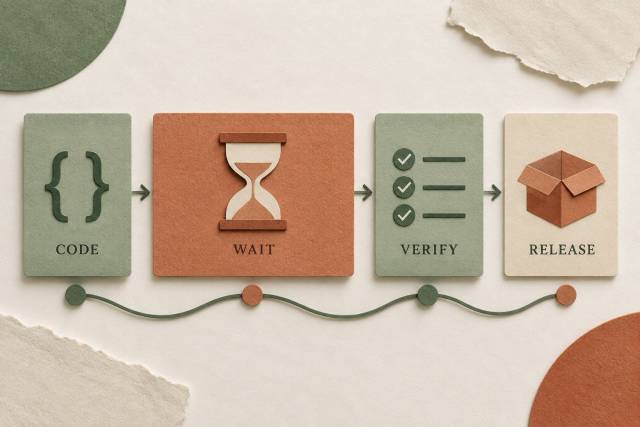
Software delivery estimates should cover the path from an agreed requirement to a usable release. Coding time is one part of that path. Review queues, test data, external approvals, migration preparation, and acceptance can determine the actual date.
Quick answer: Map the work and waiting required to release, identify dependencies, and estimate uncertain parts separately. Use recent comparable deliveries where possible. Communicate a forecast range with its assumptions, and update it when evidence changes.
Build software delivery estimates around the outcome
Consider a hypothetical WordPress team integrating a provider's payment webhook. “Two days for the handler” could be a reasonable implementation estimate and still be a poor delivery estimate.
The complete outcome may require provider approval, signature verification, duplicate delivery handling, retry behavior, support documentation, and a release procedure. Those responsibilities do not disappear because the endpoint is short.
Write acceptance criteria before asking for a date. Identify what the first release must do and what can wait. An estimate for an undefined outcome mostly measures how differently people are imagining the work.
Map active work and waiting separately
Use a simple worksheet:
| Stage | Active work | Waiting or dependency | Evidence of completion |
|---|---|---|---|
| Scope | Confirm event semantics | Provider approval | Versioned webhook agreement |
| Implementation | Handler and signature checks | Sandbox credentials | Automated checks |
| Review | Examine correctness and maintainability | Reviewer availability | Resolved findings |
| Validation | Duplicate and delayed-delivery tests | Provider retry sandbox | Recorded results |
| Release | Package, deploy, verify | Release window | Working production behavior |
Mark which stages can overlap and which cannot. The elapsed forecast follows the dependent sequence, not the sum of everyone's work hours divided by team size.
DORA's loosely coupled teams guidance explicitly considers handoffs and waits for reviews, approvals, and other teams. That makes dependency ownership a practical forecasting concern, not merely an architecture discussion.
Should software estimates be in hours or days?
Use hours when discussing bounded effort and calendar or working days when discussing delivery. State which you mean. Two hours of review effort may require two working days of elapsed time if the reviewer is unavailable.
Should testing be included in development estimates?
It must be included somewhere in the delivery forecast with clear ownership. Treating testing as an unplanned activity after coding makes the delivery date misleading, even when another team performs it.
Time-box the unknown before estimating the solution
Sometimes the uncertainty is whether the approach will work at all. For example, the team may not know whether the provider retries failed deliveries and preserves a stable event identifier.
Create a bounded investigation with a question and an exit condition: demonstrate a failed delivery followed by redelivery, then recommend the deduplication and recovery approach.
An investigation ending without a conclusive result is still information. Report what remains unknown and choose whether to investigate further, change the approach, or decline the commitment. Do not relabel unresolved research as implementation that is “almost complete.”
Use history carefully
Find a few completed changes with similar uncertainty and delivery conditions. Include the time they spent waiting. If the last three webhook integrations took four, six, and nine working days from ready to released, that spread is more informative than assuming this one must fit into four.
Those three observations do not establish a statistically reliable confidence interval. Use them to start a conversation about differences: a different retry policy, a new signature scheme, missing reviewers, or simpler scope.
Track active work separately if you need it for staffing. Track elapsed delivery time if you need it for a customer commitment. Label each measure so people do not compare them as though they were interchangeable.
Explain contingency in plain language
A useful forecast might read:
We expect five to eight working days after the provider approves the endpoint and enables sandbox retries. The largest uncertainty is duplicate delivery handling. If the provider cannot supply a stable event identifier, we will revise the design and forecast after the investigation.
The numbers are illustrative, not a recommended buffer. Tie contingency to an identified risk or observed variation. Hidden padding invites people to strip it out because they cannot see what it protects.
When the business needs a fixed date, negotiate the scope and acceptable risk around that constraint. My guide to aligning roadmaps with team capacity discusses that conversation at the planning level.
Keep the estimate useful after kickoff
Record the initial assumptions. At each milestone, ask which are now confirmed, invalidated, or still unknown. Revise the forecast when a material assumption changes.
Do not repeatedly re-estimate an unchanged backlog simply to produce a new number. Focus on evidence that changes the decision: a working integration, a failed migration rehearsal, or a newly unavailable dependency owner.
Keep developer implementation choices with the team. The manager's contribution is to secure decisions and capacity, not to prescribe every internal step. That is part of keeping team management lean.
Can AI make estimates shorter?
It can reduce some work, but the effect depends on the task and the surrounding workflow. Measure the changed work and its review consequences before changing the whole delivery forecast.
If you need an independent review of a difficult delivery plan, my technical consulting work connects the roadmap with the codebase, workflow, and operational constraints.