
Leadership
Async Decision-Making for Remote Development Teams
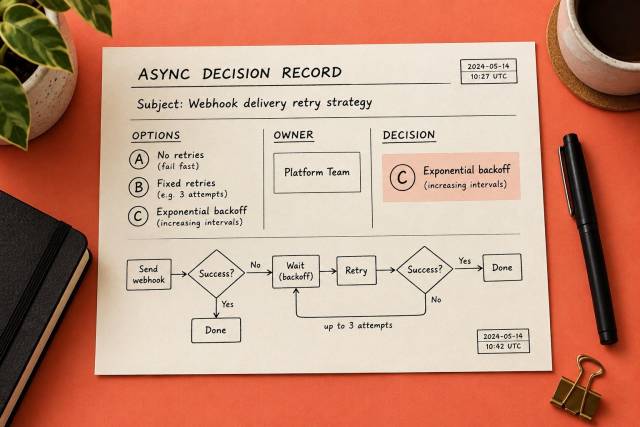
A webhook retry decision is waiting in a comment thread. Several developers have offered preferences, but nobody has said who will operate the queue. Async decision-making needs a decision record that closes that gap, not another round of opinions.
Write a proposal people can answer
Consider this hypothetical proposal for outbound webhook delivery:
Question: How should failed outbound webhook deliveries be retried?
Constraint: A recipient outage must not block the customer checkout request.
Option A: Bounded automatic retries with a visible terminal failure state.
Option B: A single attempt with support-triggered manual redelivery.
Recommendation: A, provided Operations accepts queue and alert ownership.
Decision owner: Technical lead; Product confirms customer-visible behavior.
Input needed: Recipient idempotency, retry test results, named queue owner.
Feedback closes: Thursday 15:00 Asia/Manila.
If evidence is missing: Extend the investigation and revise the release forecast.
Record location: Linked project decision page.
The important detail is the decision boundary. Product does not declare an unsafe implementation feasible, and the technical lead does not silently remove a promised customer capability.
Use real dates and time zones in the actual proposal. “By end of day” is ambiguous across a distributed team.
Give async decision-making an owner
A facilitator organizes the discussion. A decision owner is accountable for choosing within an agreed scope. One person can do both, but the responsibilities should be explicit.
For a local implementation detail, the developer may be the owner. A change to the customer promise belongs with the appropriate product or business owner. A security or operational decision may require another accountable role.
Do not make every choice the manager's responsibility. Define the boundaries in advance so the team can proceed without escalating routine decisions.
Does asynchronous decision-making require consensus?
No. It requires appropriate input and a clearly accountable owner. Consensus may be useful for some choices, but making it the default can leave decisions unresolved whenever preferences differ.
Give people a realistic opportunity to respond
Choose the feedback window according to consequence, urgency, and working-hour overlap. A reversible local choice may need a short window. A cross-team contract change needs enough time for affected owners to evaluate it.
GitLab's remote operating guidance describes decision ownership and opportunities for people in other time zones to contribute. The broader lesson is to design participation intentionally rather than equating attendance with agreement.
Name whose input is required and whose feedback is optional. Silence from a required approver is not approval. For optional input, explain whether the owner will proceed after the window closes.
How long should a feedback window last?
Long enough for required contributors to respond during normal working hours and evaluate the consequence. Choose based on the decision rather than imposing one universal duration.
Separate objections from preferences
Ask reviewers to explain consequences. “I prefer retries” is less useful than “the recipient cannot deduplicate events, so automatic redelivery may repeat a customer action.”
A consequential objection should change the recommendation or trigger more investigation. A preference may be worth considering without stopping the decision.
The owner should respond to material concerns in the final record. People do not need their preferred option to win, but they should be able to see that the relevant evidence was considered.
Close the decision explicitly
A final record needs the choice, rationale, affected work, owner, and conditions for reconsideration. For the webhook example, reconsideration might follow a recipient changing its deduplication contract or Operations being unable to support the retry queue.
Mark superseded decisions and link to their replacements. Do not overwrite history so thoroughly that a future maintainer cannot understand why the system changed.
This is one practical response to the hidden costs of missing documentation. The record belongs with the work, where someone implementing or maintaining it can find it.
What if new evidence arrives after the decision?
Compare it with the recorded assumptions and reconsideration conditions. Reopen the decision when the evidence changes the tradeoff, not simply because someone repeats a previously considered preference.
If your team is waiting on decisions more often than code, I can help clarify ownership and collaboration through my technical leadership consulting.
Know when a call is cheaper
Written discussion can struggle when people use the same term differently, disagreement is becoming personal, or several constraints need to be reconciled together.
Convene a short call with the necessary participants. State the unresolved question and preserve the written context. Afterward, record the decision and reasoning so absent colleagues do not inherit a mysterious conclusion.
Avoid a meeting that starts from zero because nobody read the proposal. That spends both the writing time and the meeting time without gaining the benefit of either.
Delegate within clear boundaries
A manager should not have to approve every small reversible choice. Agree which decisions the team can make, which require consultation, and which need explicit approval because they change a public contract or operational risk.
My article on helping developers see the bigger picture explains why business context makes that autonomy more useful. Good delegation includes the purpose and constraints, not just permission to choose.