
Development
Newscura: My Friend Built a Real News Curator With AI
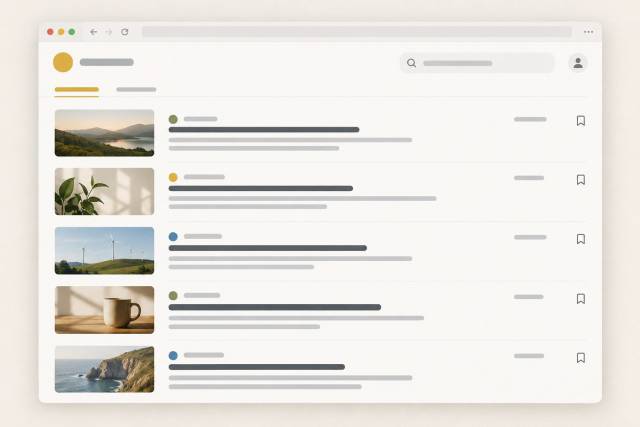
My friend Ronald built Newscura with help from AI, so I opened it expecting to inspect an interesting experiment. What I found was a working news product with a clear point of view.
Newscura does not try to become another publisher or trap every story inside its own brand. It brings RSS and YouTube sources into compact feeds, lets readers follow publishers and public curations, and keeps the original source visible. It also has the less glamorous parts that separate a product from a demo: accounts, saved stories, read state, country preferences, search, discussions, responsive navigation, legal pages, and keyboard shortcuts.
That is what made it worth writing about. The interesting part is not simply that AI helped produce code. It is that Ronald used it to turn an idea into a coherent service people can actually explore.
What is Newscura?
Quick answer: Newscura is a focused news reader for curated RSS and YouTube feeds. It leads with stories for the reader's selected country, supports public topic-based curations and individual publisher subscriptions, provides a compact article preview, and links each story back to its original publisher.
The Newscura About page describes the goal as replacing a dozen open tabs with one compact list. That description matches the experience.
I could open the main feed, browse curations, explore publishers, read summaries, and open original articles without creating an account. Registration adds the personal layer: following curations, building My Feeds, and keeping saved stories synchronized across devices.
Newscura starts with focus instead of infinite choice
The first screen is called For You, but it is not presented like a social network trying to learn every impulse. It starts with the country the reader selects and shows a straightforward list of recent stories.
Each row gives me the information I need to decide whether to continue:
- Publisher
- Curation that supplied the story
- Publication time
- Headline and short summary
- Thumbnail when available
- Controls to open, save, or preview the story
Clicking a row opens a reading preview without losing the list behind it. A clear Read more path still sends the reader to the publisher. Newscura states that it indexes and summarizes while the journalism remains the property of the newsroom that produced it.
That attribution model matters. A curator is useful when it helps readers find worthwhile reporting. It becomes much less useful when it blurs where the reporting came from.
Country-first discovery gives the product a useful shape
Newscura's local starting point is one of its strongest choices. During my review, the curation directory offered a Global option plus 22 country choices across Asia, the Middle East, Africa, Europe, North America, South America, and Australia.
The Philippines experience already feels intentionally local. I found collections for national headlines, technology and gadgets, personal finance, the stock market, podcasts, Bisaya coverage, agriculture, cycling, Filipino workers abroad, food, entertainment, and other interests that rarely fit neatly inside one traditional news homepage.
This is more useful than taking a generic global feed and adding a country dropdown as an afterthought. The country helps define what appears first, while public curations let readers go narrower.
Reader-built curations are the real product
The most important object in Newscura is not the individual article. It is the curation.
A curation combines several feeds around a topic. Its public page can include a description, topic labels, source list, follower count, article stream, and discussion area. Readers can follow the whole collection instead of finding and maintaining every underlying feed themselves.
For example, the public Philippines News Feeds curation brings together national, business, regional, government, technology, entertainment, and diaspora coverage. Other curations are narrower and more personal, such as Pinoy Podcasts, Ipon at Puhunan, Pinoy Cycling Community, Agri Negosyo, and Off the Map PH.
At the time I visited, the directory exposed 81 topic labels. The interesting thing is not the number, which will change. It is the model: a useful feed can be assembled once, published, discovered, and followed by other readers.
According to the About page, a reader can also build My Feeds from any RSS feed and publish the result as a curation. That turns Newscura from a fixed directory into a community curation tool.
Publishers remain first-class sources
Readers do not have to follow a bundled curation. The publisher directory also lets them search for and subscribe to individual sources.
The directory includes conventional news sites, specialist publications, government sources, blogs, and YouTube channels. Publisher pages show where a source appears across public curations, which makes the relationship between a publisher and a collection understandable.
This gives readers two useful ways to shape My Feeds:
- Follow a curator's judgment across several sources.
- Follow a particular publisher directly.
Those are different preferences, and Newscura supports both instead of forcing everything into one recommendation system.
The News Timeline is more useful than another reverse-chronological list
The feature I found most interesting is the News Timeline.
It organizes the last 24 hours into time blocks and presents stories as events rather than a flat stream of links. Each entry includes a compact explanation of why the development matters, a category, a publisher, and timing. Some entries also indicate that another source covered the event or that the story received an update.
That structure helps with a common news-reading problem. Ten publishers may report the same development at slightly different times, while a genuinely important update can disappear between duplicate headlines. A timeline gives the reader a better sense of what happened and when.
I cannot tell from the public interface exactly how Newscura clusters, summarizes, or ranks those events. That is one area where more public explanation would strengthen trust as the service grows. Still, the result is clearly more intentional than sorting raw feed items by timestamp.
Small interaction details make it feel like a product
Newscura's interface is compact and responsive. On a narrow screen, its main sections move into a bottom navigation bar. On larger screens, the navigation has more room without turning the reader into a dashboard full of panels.
The guided tour explains the main model in four short steps, then reveals two keyboard shortcuts:
Ctrl+Kjumps between views.Ctrl+\collapses the sidebar.
There is also a light and dark appearance control. Saved stories, read state, followed publishers, and country selection give returning readers continuity. Public curation discussions support Best, New, and Top sorting, while signing in is required to vote or participate.
None of these details is revolutionary by itself. Together, they show product thinking. Ronald did not stop when the first list of headlines rendered.
Yes, Newscura uses React and Next.js
React is not a programming language. It is a JavaScript library for building interfaces. Newscura's public frontend does use it.
I verified an active React renderer in the browser. The delivered assets use Next.js paths, and the server response identifies Next.js directly. The site is delivered through Cloudflare, with Caddy also visible in the request path.
That tells me what reaches the browser. It does not tell me whether Ronald wrote the application in JavaScript or TypeScript, how the backend is organized, which database it uses, or which AI coding tools helped him. I do not have the source repository, so I am not going to invent the missing parts.
What I can say is that this is not a static mockup. The public experience includes server-backed accounts, personalized state, continuously updated feeds, searchable directories, discussions, and country-specific timelines.
What an AI-assisted build does and does not prove
I have already written about vibe coding an internal PHP application and reviewing AI-generated code without fooling yourself. Newscura reinforces the same lesson from another direction.
AI can help a capable builder move across unfamiliar parts of a stack, produce interface components, connect APIs, investigate failures, and iterate faster. It can reduce the distance between a product idea and something testable.
But AI does not choose the product's point of view on its own.
Someone still had to decide that country should lead the feed, that curations and publishers deserve separate discovery paths, that readers should see the original source, that a timeline is different from a latest-news list, and that mobile navigation should remain compact. Someone had to keep testing the workflows and reject the output that did not fit.
Those decisions are Ronald's contribution. The fact that AI helped write parts of the system does not make them less important.
The reverse is also true. A polished interface does not prove that the code is secure, maintainable, or ready for unlimited scale. Only source review, automated tests, operational evidence, and continued use can establish that. AI-assisted development deserves neither automatic dismissal nor automatic trust.
What I like, and what I would clarify next
Newscura already gets several product decisions right:
- It has a concise purpose.
- It treats local coverage as a starting point.
- It gives curations a public, followable identity.
- It keeps publishers visible throughout the reading flow.
- It supports direct publisher subscriptions as well as bundled feeds.
- It works as a public discovery tool before asking for registration.
- It has enough account and interaction detail to support repeat use.
As it develops, I would make the content-processing rules easier to inspect. Readers should be able to tell whether a summary came from a publisher, Newscura's own processing, or an AI model. The timeline could also explain how it groups related coverage and chooses the short statement about why an event matters.
I would treat curation quality and moderation as core product work too. Public collections become more valuable as more people build them, but that growth also creates duplicate, abandoned, misleading, or low-quality feeds. Clear ownership, reporting, moderation, and update signals will matter.
Newscura's privacy page says it collects account details, follows, reading activity, country, and display preferences to operate the service, and that it does not sell or share that data. Keeping those explanations specific as the product changes will be important for reader trust.
These are growth questions, not reasons to dismiss the product. Ronald has already built enough of the system for the harder questions to become relevant.
Frequently Asked Questions
Who built Newscura?
My friend Ronald built Newscura with AI assistance. I am deliberately not naming unverified tools or describing private implementation details that are not visible from the public product.
Is Newscura an AI news site?
AI assisted the development of Newscura. The public pages I reviewed do not clearly state whether AI generates the article summaries or timeline entries, so I would not assume that without confirmation from Ronald.
Is Newscura built with React?
Yes. I verified that the public frontend runs React and uses Next.js. That does not reveal the complete backend stack.
Does Newscura publish its own journalism?
Newscura describes itself as an indexer and summarizer. It attributes stories to their publishers and provides links to the original articles.
Do I need an account to use Newscura?
No account was required to browse the public feed, timelines, curations, publishers, or article previews during my review. An account is required for personalized features such as following, synchronized saved stories, voting, and joining discussions.
Try Newscura
If your news routine has become a row of tabs, a noisy social feed, or an RSS collection you no longer maintain, try Newscura.
I am curious to see where Ronald takes it. More importantly, I am glad to see AI used to ship a product with a real opinion instead of another disposable demonstration. The code-generation story may get a developer's attention, but the curation model is what gives Newscura a reason to exist.