
Leadership
How to Get Developers to Raise Blockers Early
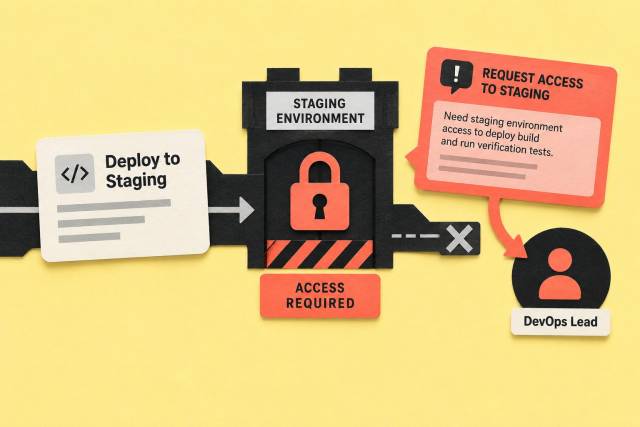
“I cannot run the staging deployment” is useful information while there is time to arrange access. Developers raise blockers early when their request reaches an owner and changes what happens next. The response below shows what that looks like.
Make the first message useful
A hypothetical developer might write:
Goal: Rehearse the release in the staging environment.
Blocked by: My account cannot run the staging deployment job.
Tried: Documented access request; the request has no assigned owner.
Impact: Thursday's release decision will lack a deployment rehearsal.
Help needed: Platform owner assigns approved access or a qualified operator.
Next action: I can finish the local recovery checklist while this is resolved.
Needed by: Wednesday noon, Asia/Manila.
The developer is not expected to solve an ownership gap before asking for help. The format simply gives the responder enough context to act.
Include links to relevant evidence, with appropriate access. Avoid making colleagues search a long chat history for the failing command or unresolved requirement.
Respond without punishing the messenger
DORA's guidance on organizational culture connects high-trust information flow with software delivery performance. Its distinction between inquiry and blame is directly useful here.
A helpful manager response is: “Thanks for flagging it. I will route the access request to the platform owner now. Continue the recovery checklist; we will review staging coverage tomorrow.”
An unhelpful response is: “Why did you let this become a problem?” before establishing when the missing dependency became knowable. If an earlier commitment was missed, discuss that separately with facts and context. Do not make every request for help feel like a disciplinary hearing.
What if the manager cannot resolve the blocker?
The manager can still establish ownership, escalate the decision, change the plan, or make the uncertainty visible. Responsibility for coordination does not require personally knowing every technical answer.
Define when to raise blockers early
A blocker prevents the next meaningful step. A risk may allow work to continue but threaten the outcome or date. A difficult task is not automatically either, although an unresolved technical unknown can become a risk.
Give the team examples:
| Situation | Expected response |
|---|---|
| Required access is missing | Request it from the named owner and flag the delivery impact |
| Acceptance criteria conflict | Ask the product owner to resolve the specific contradiction |
| A technical approach remains unproven | State the uncertainty and propose a bounded investigation |
| A review waits beyond agreed coverage | Ask the review backup to route or take it |
| An active production incident occurs | Use the incident escalation process immediately |
Set thresholds according to consequence. There is no universal rule that every technical question must be escalated after thirty minutes. A security boundary and a cosmetic preference need different treatment.
How long should a developer try before asking for help?
Agree on a limit based on the task's uncertainty and consequence. For a bounded investigation, use its planned checkpoint. Escalate immediately when the issue affects safety, access, or a decision outside the developer's authority.
Make asking safe and responding reliable
Psychological safety does not mean every concern receives its preferred solution. It means people can surface relevant information without being punished for doing so.
The manager still needs to decide, delegate, or explain why action must wait. A supportive emoji without a next step can leave the blocker unchanged.
Name a backup for periods when the usual owner is unavailable. In remote teams, “ask me any time” is weaker than a clear route that works across working hours. Remote PHP team management without burnout includes the importance of boundaries and explicit availability.
Should blockers be public or private?
Project blockers usually belong in the shared work record so relevant people can help. Personal concerns or sensitive details may need a private conversation, with only the necessary delivery implications shared more broadly.
Coach late reporting with specifics
If a developer repeatedly waits too long, ask what happened. They may have believed asking would signal incompetence, expected the manager to react badly, or lacked a clear escalation threshold.
Agree on a concrete change for the next task. For example, report when the investigation reaches its agreed time limit without resolving the feasibility question. Review whether the new agreement helped.
This is part of supporting team growth without micromanaging: clear expectations, room to act, and coaching based on observed behavior.
Separate patterns from isolated events
Review a few blockers at the retrospective. Did the same permission request recur? Did several tasks depend on one specialist? Did a product decision remain unresolved despite repeated requests?
Fix the recurring cause. An owned staging-access process, a documented decision boundary, or backup review coverage can remove an entire category of interruption.
Do not reward the number of blockers reported. That encourages noise. Look for timely, useful information and fewer repeated delays.
If your team discovers blockers early but resolves them late, my consulting services can help examine the ownership and workflow behind the delay.