
Management
Track Remote Development Progress Without Micromanaging
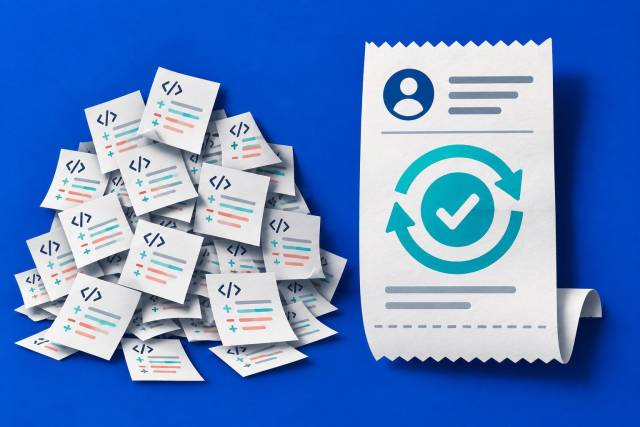
Remote development progress is easiest to track when you can connect an agreed outcome to working evidence, the next milestone, and any decision blocking delivery. A green chat indicator tells you none of those things.
Quick answer: Use one shared progress record per meaningful outcome. Record what has been accepted, what remains uncertain, who owns the next action, and when you will review the forecast. Discuss changes and blockers rather than asking every developer to narrate their day.
What remote development progress should show
Start with a customer or operational outcome. “Change the renewal handler” describes implementation. “A member who renews can reopen their course without a support intervention” describes a customer workflow somebody can demonstrate.
That distinction matters when implementation, review, testing, and release happen in different time zones. A merged pull request can still depend on a migration or an operational decision before anyone benefits.
The SPACE framework for developer productivity explains why one activity metric cannot adequately represent productivity. Commit counts and closed tickets can help locate work, but they cannot explain its value or the conditions under which it happened.
Use a progress record that fits in one screen
Consider a hypothetical PHP membership product. A customer renews successfully, but access to a purchased course remains suspended until Support intervenes. The developer has merged a fix. The manager still needs to know whether the customer journey works and whether that behavior has reached production.
| Field | Useful update |
|---|---|
| Outcome | A renewing member regains course access automatically |
| Accepted evidence | Product demonstrated renewal followed by course access in staging |
| Remaining work | Repeated payment-notification check and release verification |
| Current risk | A repeated notification might create a second renewal event |
| Next action and owner | Maintainer reproduces notification redelivery by Tuesday |
| Forecast | Thursday if redelivery is safe and release verification passes |
| Decision needed | Release owner confirms the deployment window and recovery plan |
The accepted staging journey is real evidence within this hypothetical example. It is not evidence of a production release. Keeping both facts in the same record prevents a merged fix from becoming an exaggerated customer promise.
Link the demonstration and test results in the actual tracker. A manager can then request the specific missing check instead of asking whether the developer was busy. Use the tracker you already have; seven useful fields do not require a new productivity platform.
Turn the weekly review into decisions
A useful review can follow three questions:
- What outcome became verifiably closer to delivery?
- What changed our confidence in the forecast?
- What decision or help is needed now?
For the renewal example, the manager might arrange payment-notification expertise, confirm release coverage, or move a reviewer from lower-priority work. “Please keep the ticket updated” is not a substitute for any of those actions.
End with an owner and a next check. Avoid repeating the entire history unless somebody needs it to make the decision.
Agree on update triggers
Ask for a substantive update when evidence changes: a milestone is accepted, a blocker appears, scope changes, or a forecast moves. For active time-sensitive work, add a short regular check-in so silence does not become the reporting system.
The right cadence depends on risk. A migration this afternoon needs tighter coordination than an exploratory improvement with no external commitment. State the expected cadence at kickoff, and revise it when the work changes.
Keep the update attached to the work. Copying the same explanation into a ticket, chat thread, slide deck, and management spreadsheet creates four versions to reconcile.
Review the flow, not a ranking of people
Use the board to find work waiting for a review, unresolved decisions, and items whose age exceeds what is normal for comparable work. Then ask what would help the item move.
A developer with few commits may have prevented a production incident, reviewed difficult changes, or coached a new teammate. Investigate that context before interpreting activity as performance. For the people-management side, read my guide to supporting team growth without micromanaging.
Individual coaching belongs in a private conversation with clear expectations and examples. A public leaderboard will not explain why the shared test environment was unavailable.
Try it on one project before expanding
Choose one active outcome for the next two weeks. Replace duplicate reporting with the shared record, and ask the team whether it reduced interruptions. Check whether stakeholders can explain what is done and what still threatens the date.
If the record gets stale, first examine whether it duplicates another system or asks for too much detail. My approach to PHP team management without workflow bloat is to make the workflow earn its maintenance cost.
Questions managers ask
Should remote developers provide a daily update?
Sometimes. Daily updates help when dependencies change quickly or a deadline is close. Keep them focused on new evidence and help needed. A predictable project may need fewer updates; an incident may require much more frequent coordination.
Are story points a good progress measure?
They can support a team's own planning conversation, but completed points do not establish that a customer outcome works. Pair planning measures with acceptance evidence and remaining delivery work. Avoid comparing point totals between teams.
How do I know whether someone is actually working?
Agree on responsibilities, outcomes, communication expectations, and support. If those expectations are repeatedly unmet, address specific examples privately. Constant observation does not resolve unclear expectations or blocked work.
If your team has plenty of reporting but little delivery clarity, I can help you review the workflow and identify the smallest useful changes through my technical leadership consulting.